Local SEO citations: get the core right, then stop counting
Local SEO citations are mentions of your business name, address and phone number on other websites. For years the industry sold them by the hundred. That was always the wrong product: what matters is that the few platforms Google, Apple and Bing rely on agree with each other, and that the rest of the web talks about you.
The short answer
- Citations stop Google doubting you. They rarely push you up the map pack on their own.
- Accuracy beats volume. Five consistent listings on the right platforms outwork a hundred scattered ones.
- Build in order: Google, Apple and Bing, then the data aggregators, then the directories your customers actually use.
- Fix before you add. A duplicate profile or an old address does more damage than a missing listing.
- Then get talked about. Local press, industry sites and “best of” lists are what AI search draws on.
“How many citations do we need?” is the wrong question, and answering it is how citation budgets get wasted. The useful questions are which ones, in what order, and when to stop. That is what this guide answers.
What are local SEO citations?
A citation is any mention of your business’s name, address and phone number on a site you don’t own. Most people picture directory listings, and those are the structured kind: Google Business Profile, Apple Maps, Bing Places, Yelp, the directories in your industry. The other kind, the unstructured citation, is a mention in running text: a local news story, a trade association’s member page, a “best of” list.
The two do different jobs. Structured citations confirm your details in a format machines read easily. Unstructured ones show that people outside your business know you exist, which is a much harder thing to fake.
A citation is also not a backlink, though the best ones are both. A local paper that names your practice and links to it is worth more than any directory you will ever pay for.
Your profile is a claim. Citations are the evidence.
Google does not take your Business Profile on trust. It compiles what it shows from several places: what you enter, your website, other sites it crawls, business data it licenses from third parties, and edits from the public (Google Business Profile Help). When those sources agree, your profile looks solid. When they don’t, Google has to decide who to believe, and it won’t always pick you.
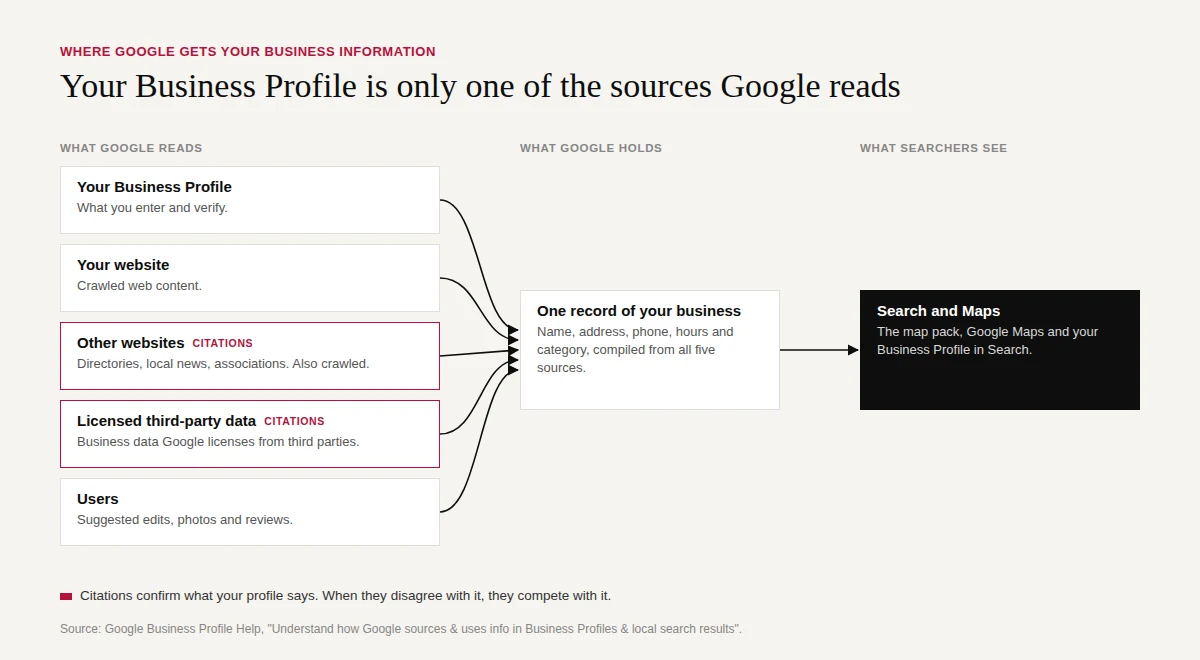
Say a dental practice moves across town. It updates its Business Profile the same week, but the old address lives on in a dozen directories and in the data an aggregator still sells. Every one of those listings is a small vote for the wrong building. Nothing breaks overnight; the practice just becomes slightly harder for Google to be sure about, and in a competitive map pack, slightly is enough.
Accuracy is only half of it. Google ranks local results on relevance, distance and how well-known a business is, and that last one is built outside your own site. A Texas personal injury firm we worked with came to us with a strong reputation and zero organic visibility. Reputation does not rank on its own: Google has to find it on the web, page by page and county by county.
Do local citations still matter?
Less than they did, and differently. The map pack is now decided mostly by your category, your distance from the searcher and your reviews. Citations are what stop Google doubting the rest. Get them wrong and you can lose ground; get them right and add another hundred, and nothing happens.
The independent evidence points the same way. Joy Hawkins’ team at Sterling Sky built 50 citations at once for a dentist and a handyman: local pack rankings didn’t move, and six months later only two of each set were still in Google’s index (Sterling Sky). Whitespark’s survey of 47 local search specialists ranks directory volume 110th of 187 factors for the map pack.
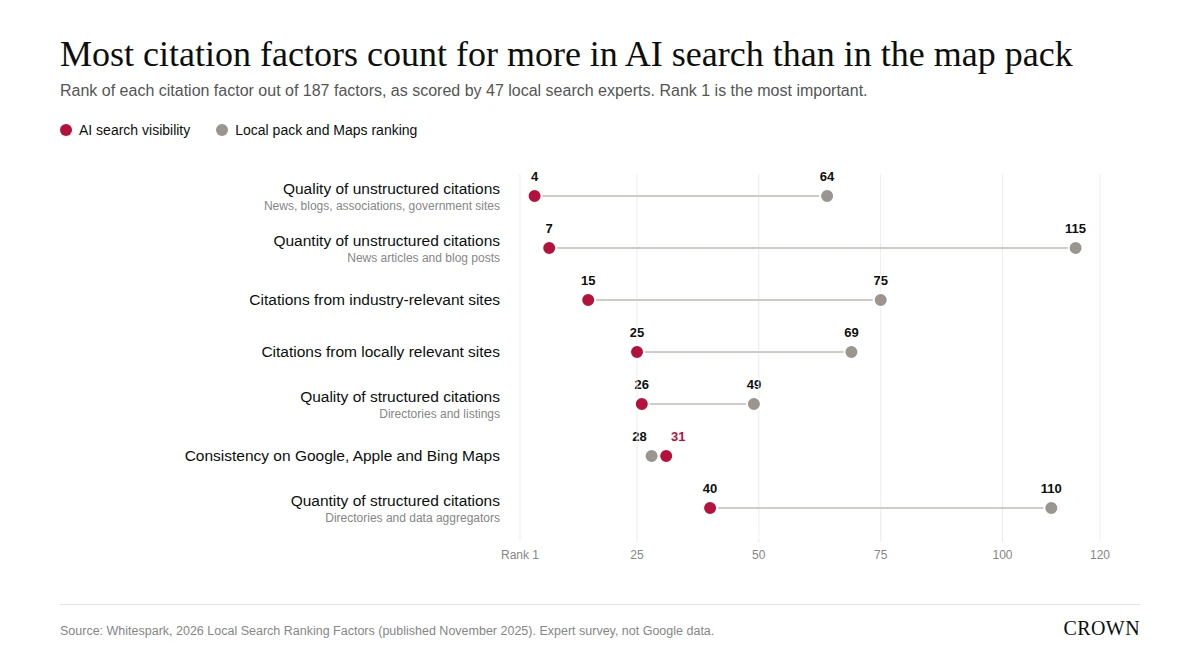
Where citations have come back is AI search. The same specialists rank mentions in news, associations and blogs 4th for AI visibility, and a place on expert-curated “best of” lists first of all. That fits how these systems work: they recommend businesses the wider web already vouches for. The effort shifts from being listed to being talked about.
It is still a debated area, and survey rankings are opinion, not measurement. But every source we trust points in the same direction, and so does the logic.
Local citation building: what we would build, in order
If we were starting your citations from nothing, this is the order we would work in, and where we would stop:
- One master record of your business details.
- Google Business Profile, Apple Business Connect and Bing Places.
- The data aggregators that supply other directories.
- The directories and review sites your customers use.
- Then stop listing, and start earning mentions.
Start with one master record
Before anyone submits anything, write down the exact name, address, phone number, website, categories and hours, and copy from that document every time. Use the name on your signage, not a keyword-stuffed version of it, and a local phone number rather than a call centre. Inconsistency rarely starts with a big mistake. It starts with “Suite 4” on one site and “#4” on the next.
Then the three map platforms
Google, Apple and Bing power the maps your customers actually open, so they come first and get the most care. Choose the fewest categories that describe what you really do. Categories deserve as much attention as the listings themselves: for a multi-location HVAC client across five Southwest markets, the Business Profile category restructure runs alongside our citation programme.
Then the aggregators
In the US, Data Axle, Foursquare and TransUnion (formerly Neustar Localeze) supply business data to a long tail of other sites. Correct your details there and the fix spreads; skip them, and you will be correcting the same old address one directory at a time for years.
Then the directories your customers use
For a law firm that means the legal directories; for a contractor, the trade platforms; for a clinic, the healthcare ones. One directory your buyers actually browse beats twenty they have never heard of, and many of the good ones are paid listings that bulk packages never include.
Then stop
There is no magic number, and we would be wary of anyone who sells one. Joy Hawkins reports that, across her team’s tests, 10 to 20 citations is usually the most Google will keep indexed. Past the core and your industry’s directories, the next hour is better spent earning a mention than adding a listing. IT services firms and MSPs selling within a region need all of this; software companies selling nationally can skip it, as we explain in SEO for technology companies.
This is how our local SEO services approach citation building and cleanup.
How to audit and fix inconsistent citations
Most businesses do not need more citations. They need the ones they already have to agree. These are the checks our citation audits start with:
- Search your phone number, and every old address and number, in Google.
- Look for duplicate Business Profiles and duplicate directory listings.
- Check the data aggregators, because they feed everyone else.
- Correct old details at the source, not only on Google.
- Repeat after any move, rebrand or number change.
Duplicates come first. Google’s rule is plain, “There should only be one profile per business”, and a second one splits your reviews and confuses Maps. Merge or remove it before you touch anything else.
Use a tool to find listings and a person to judge them. Software will flag the “wrong” number on a listing; only someone who knows the business will recognise it as the line that still rings at the front desk.
Local citations for AI search
AI assistants recommend the businesses the wider web already vouches for. That makes the unglamorous side of local SEO, being mentioned by people who are not you, suddenly the important side. Every one of the 19 searches about local citations in our keyword data now shows a Google AI Overview, and our research on AI Overviews explains how they choose their sources.
Three things move the needle. Get onto the expert-curated “best of” lists for your city and service, which you do by being good and by being known to the people who write them. Get mentioned by trade associations, local news and chambers of commerce, which is where our link building and local work meet. And collect reviews beyond Google, so the rest of the web is not silent about you.
Nobody can guarantee an AI recommendation. We track AI answers for each priority search and judge them by the enquiries they produce, which is the core of our AI SEO and GEO work.
What local authority is worth
Your map pack position is your most valuable piece of digital real estate. Here is the rest of the Texas firm’s story.
The firm’s previous agency had spent 14 months publishing blog content that produced no commercial rankings. Within 12 months of working with us, it ranked first for its primary commercial keywords and #1 in the map pack.
We rebuilt the technical foundation, restructured the practice area pages, built local authority across 12 counties and earned links on real publications. The client is anonymised for confidentiality. Read the full law firm local SEO case study, or see our lawyer SEO services.
How we build local authority
Every local engagement runs through the five phases of our REIGN framework, built bespoke for each client. Nobody can guarantee a map pack position, and Google says there is “no way to request or pay for a better local ranking”. What we commit to is finding what holds you back, fixing it in the right order, and measuring what it is worth.
- Reconnaissance
Find what Google believes about you
A citation audit across the map platforms, aggregators and directories, duplicate profiles, and the listings and mentions behind every business in your map pack.
- Engineering
Fix before you build
Duplicates and wrong details first, then the core platforms, then the gaps that matter. Each one is ranked by the searches and enquiries it affects.
- Implementation
Build it in-house
Google Business Profile optimisation, citation building and cleanup, review strategy and local mentions. Nothing is outsourced.
- Governing
Report on enquiries
Map pack positions for each priority search, AI answers, calls and enquiries by location. When Google confirms a core update, we assess every account within 48 hours.
- Nationwide Dominance
Expand area by area
Into the next county, city or location, with the same record and the same order, as we did across 12 Texas counties.
Three citation mistakes that cost local businesses
Paying for volume
Bulk packages and annual subscriptions put you on sites nobody visits and Google often does not keep indexed. Before you renew one, check how many of those listings Google can actually find.
Fixing Google and nowhere else
Update your Business Profile while the aggregators still hold the old address, and the old details stay in circulation on every site they supply.
Listing an address you don’t work from
Google’s guidelines rule out P.O. boxes, and virtual offices unless they are staffed during business hours. If customers never visit you, clear the address and set a service area instead.
Local SEO citations: frequently asked questions
What are local SEO citations?
Mentions of your business name, address and phone number on other websites, with or without a link. Structured citations are listings such as Google Business Profile, Apple Maps, Bing Places and industry directories. Unstructured citations are mentions in running text: local news, association pages, “best of” lists.
How many citations does a local business need?
There is no magic number. Cover Google, Apple and Bing, the main data aggregators and the directories your customers use. Joy Hawkins of Sterling Sky reports that 10 to 20 citations is usually the most Google will keep indexed, so past that point, earning mentions is a better use of time than adding listings.
Are citations the same as backlinks?
No. A citation needs your business details but not a link; a backlink needs a link but not your address. The best mentions are both, such as a local news story that names your business and links to your site.
How long do citations take to affect local rankings?
Corrections on Google, Apple and Bing show as soon as each platform accepts them. Changes sent through data aggregators take longer, because each site they supply updates on its own schedule. Expect citations to remove a problem more often than to create a jump.
Do citations help you appear in ChatGPT and Google AI Overviews?
Mentions on trusted sites do. In Whitespark’s 2026 survey of 47 local search specialists, the quality of unstructured citations ranks 4th of 187 factors for AI search visibility, and expert-curated “best of” lists rank 1st. Directory volume ranks far lower.
Should I pay for a citation service?
Use a tool to find and submit listings, and a person to check them. Before you renew an annual subscription, check how many of the listings it maintains Google actually keeps indexed. If most are not, the money is better spent on the directories your customers use and on earning mentions.