Local SEO: what actually moves the map pack
Local SEO is the work that decides whether your business appears when someone nearby searches for what you do: in the map pack, in Google Maps and in the local results below them. Three things decide most of the map pack: your primary category, how close you are to the searcher and your reviews. Much of what else gets sold as local SEO barely registers. This local SEO guide is ordered by what moves rankings and calls.
The short answer
- There are two local rankings, not one. The map pack runs on your Business Profile, location and reviews; the local results below it run on your website and links.
- Fix what Google believes before you build anything. A wrong category, a duplicate profile or an old address in the data aggregators outweighs months of posting.
- Category, honest hours and a steady flow of reviews are the controllable factors that matter most in the map pack.
- Measure calls, not just rankings. AI local packs and ads are taking clicks from businesses that still “rank first”.
- Get talked about. Mentions on local and industry sites now feed AI answers as well as rankings.
Most local SEO advice is a list of fifteen tips of equal weight. They are not of equal weight, and treating them as if they were is how a business ends up posting to its profile every week while the wrong category quietly holds it out of the map pack. This guide is also dated, because local search changed more in 2026 than in the five years before it.
What is local SEO?
Local SEO, or local search engine optimization, is making a business visible to people searching for it in a specific place, whether they type “near me”, name a city or simply search from their phone. It covers two different results on the same page, and the first job is to stop treating them as one.
The map pack (also called the local pack or 3-pack) is the map with a short list of businesses that sits at the top of a local search, and the same listings in Google Maps. It is drawn from Google Business Profiles. Local organic results are the ordinary web pages below it, ranked much as any web page is ranked, with location added to the mix.
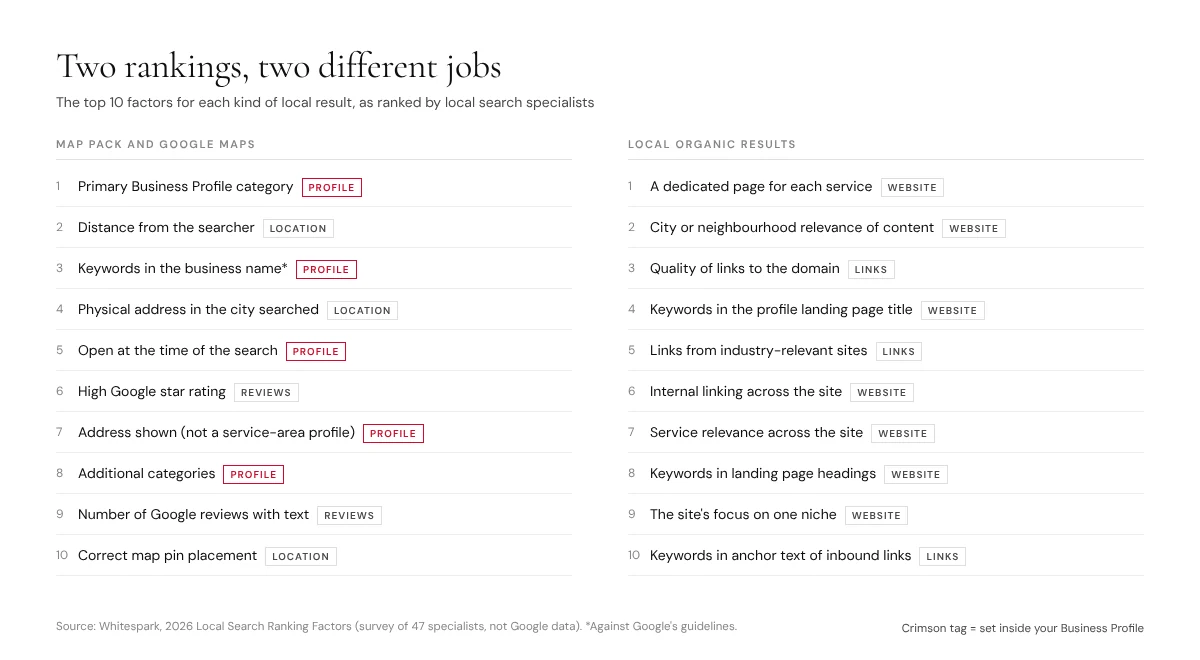
Look at how little the two lists share. Eight of the map pack’s top ten are set inside your Business Profile or fixed by where you are; all ten of the organic top ten live on your website or in its links. A business can hold the top of one and be invisible in the other, and an agency that reports “local rankings” as a single number is usually hiding that.
This guide does not explain SEO in general. If you sell nationally rather than to a place, most of it does not apply to you; our guide to SEO for technology companies covers where the two meet.
How Google ranks local businesses
Google ranks local results on three things, and you control only two of them. In its own words, local results are “mainly based on relevance, distance, and popularity” (Google Business Profile Help). Relevance is how well your profile matches the search, distance is how far you are from the searcher, and prominence (Google still uses that word in the detail) is how well known you are, from links and reviews to how often you are mentioned.
Distance is the one you cannot change, which is why it is the one most often argued with. A business two miles outside the centre of town will not out-rank one on the high street for a searcher standing on the high street, however good its profile. What you can do is make sure distance is the only thing counting against you.
Relevance is where most of the easy wins sit, and the primary category is the biggest of them. In 83% of the local businesses we audit, the primary category is wrong: close enough that nobody noticed, wrong enough to hold the profile back on the searches that matter. A single-location legal practice came to us with exactly that, plus its details recorded inconsistently across 14 citation sources. We corrected both and added LocalBusiness markup to its site. Within 90 days it held top-three map pack positions for 27 high-intent searches, and enquiries tripled with no extra ad spend.
Nothing about the firm had changed. Google could simply match it to the right searches, and believe it.
What changed in local search in 2026
The map pack now shares the page with AI answers and more ads, and Google is enforcing its rules on reviews and profiles harder than before. Here is what changed, dated and sourced, with what we would do about each. We review this list every month.
AI local packs replace the 3-pack on some mobile searches
Joy Hawkins’ team at Sterling Sky found AI local packs on about 7% of the keywords they track, later 8%, mobile and US only. They often show one or two businesses, many have no call button, and across 322 markets they surfaced 5,943 unique businesses against 18,330 in regular 3-packs: about a third as many (Sterling Sky).
What to do: most rank trackers cannot see these packs yet, so check your priority searches on a phone and judge local SEO on calls, not positions.
More paid placements above the map pack
In Sterling Sky’s ranking reports, ads inside the local pack went from 1% of mobile reports to almost 22% over 2025, and Local Services Ads from about 11% of tracked searches to 31%. Calls from top-ranked profiles fell year on year across 179 profiles they analysed with Jepto.
What to do: if your calls fell while your rankings held, this is the likeliest reason. In categories with Local Services Ads, test them alongside organic work; they keep the call button organic listings are losing.
Ask Maps launches in Google Maps
A conversational Gemini feature in Maps, in the US and India, that “analyzes information from over 300 million places, including reviews” and personalises answers to places people have searched or saved (Google).
What to do: complete attributes and services, and reviews that describe what you actually did, are what an AI can quote back to a searcher. Thin profiles give it nothing to say.
Reviews vanish from many profiles
Businesses lost reviews in large numbers, many reporting a wave of fake reviews just before, and new reviews were paused. Google said its systems may remove reviews and pause new ones when they detect suspicious activity, and that it would “restore any reviews that were incorrectly removed” (Search Engine Roundtable).
What to do: screenshot your review count monthly, so you can show support what was there, and report spam reviews as they arrive rather than in bulk.
Maps requires sign-in to read all reviews; a map pin bug
Google Maps began asking people to sign in to see every review on a profile, and a bug placed some businesses’ pins in the wrong place, some in the middle of the ocean. Google also added a “Misuse of support channels” policy (Sterling Sky’s change log).
What to do: check your pin after any edit. Pin placement ranks 10th of 187 factors for the map pack in Whitespark’s survey.
Stricter rules on what profiles and posts can say
Google updated the advertising and solicitation section of its prohibited and restricted content policy for Maps and Business Profiles, setting out what merchants cannot post in listings or posts.
What to do: keep posts to real news, offers and events, and keep phone numbers and links out of places the policy does not allow them.
Review appeals delayed again; verification by government ID
Dan Boguslavsky of Google posted that review appeals are delayed again, and Google began testing verification by uploading a photo of a government ID.
What to do: expect appeals to be slow. Keep the evidence for each disputed review (dates, booking records) so one appeal is enough.
A new home for profiles, and new requests for business details
Google launched “Google Business Home” in beta and tested revamped performance reports. It began asking some businesses for their EIN and a privacy policy link, and started adding Facebook Messenger links to profiles automatically.
What to do: check your profile for links you did not add, and answer verification requests from the business’s own Google account, not an agency’s.
The “diversity update”: one URL, one result
Joy Hawkins named it: if the page your profile links to ranks in the map pack, Google may drop that same page from the first page of organic results. Colan Nielsen traced it to about August 2024. Google has not confirmed it, and it does not happen every time (Search Engine Roundtable).
What to do: see the diagnostic below before changing the URL on your profile; it is a trade-off, not a free win.
How to do local SEO: the order we work in
Order matters more than effort in local SEO. Building on top of bad data multiplies the problem, so we fix what Google believes first, then compete. This is the sequence we follow on every local engagement:
- Fix what Google believes about you.
- Get the categories and services right.
- Set your address, service area and hours honestly.
- Build the page your profile links to.
- Build a steady flow of reviews.
- Earn local mentions and links.
- Measure calls and bookings, not just positions.
1. Fix what Google believes about you
Find and fix duplicates, old addresses and wrong details before adding anything. Google builds your profile from what you enter, your website, other sites, licensed third-party data and public edits, and when those disagree it decides who to believe. Our guide to local citations covers the audit in detail.
We picked up a dental practice that had run local SEO with another agency for 14 months. The profile was optimised, the reviews were good and the schema was in place, yet it sat at position seven for its main search. Our citation audit found the cause within 48 hours: a data aggregator was still sending an old suite number, from three years earlier, to 67 directories, and over 60% of its citations disagreed with the profile.
We corrected the record at the aggregator. Within six weeks the practice was at position two, and within three months position one. The previous agency had spent 14 months building new citations on top of the contaminated data, compounding the problem it was paid to solve.
2. Get the categories and services right
Choose the primary category that matches your most valuable searches, then add only the additional categories you genuinely serve. The primary category ranks first of 187 factors in Whitespark’s survey and additional categories eighth. Look at which category the businesses in your map pack use; Google often has a narrower one than the obvious choice.
Then fill in the predefined services Google suggests for your category. Specialists moved them up to 22nd after Joy Hawkins’ testing showed they affect rankings, and Darren Shaw confirmed it in his own tests. It is ten minutes’ work most profiles have never had.
3. Set your address, service area and hours honestly
Show the address customers visit, set the hours you actually open, and use the name on your signage. Each of these is a ranking factor, and each is tempting to bend. Whitespark’s specialists rank “open at the time of the search” fifth: you start to drop as closing time approaches and give way to open competitors once you close.
Keywords in the business name rank third, which is why so many profiles stuff them in. Google’s guidelines are explicit that your name “should reflect your business’s real-world name”, and that unnecessary information “could result in the suspension of your Business Profile” (Google). We do not do it for clients. A suspended profile ranks for nothing, and it is your business that carries the risk, not the agency’s.
4. Build the page your profile links to
Link your profile to a page that is about the service and the place, and give every main service its own page. A dedicated page for each service is the top organic factor, and the title and headings of the page your profile links to rank 17th and 20th for the map pack too. The website is where the two rankings meet.
Put your name, address and phone number on that page exactly as they appear on the profile, and add LocalBusiness structured data. Markup will not lift you up the map pack on its own (specialists rank it 118th there), but it removes doubt about who and where you are, and it is cheap. For the technical side of this, see our technical SEO services.
5. Build a steady flow of reviews
Ask every happy customer, every week, rather than running a campaign. Specialists rank star rating 6th, review count 9th, recency 11th and a sustained flow rather than bursts 14th. A business with 60 recent reviews often outperforms one with 200 that stopped two years ago, and a sudden burst looks exactly like what Google’s spam systems are built to catch.
Reply to reviews because customers read the replies, not because of the ranking: specialists put owner responses at 122nd. And ask for reviews on the platforms your customers use beyond Google, because AI answers draw on them.
6. Earn local mentions and links
Get mentioned by local news, associations, sponsors and suppliers. Link quality is the third organic factor, and links from local and industry sites carry weight in the map pack as well. A single story in your city’s paper is worth more than any directory you will pay for. This is where our local work meets link building.
7. Measure calls and bookings, not just positions
Track calls, direction requests and bookings by location, alongside a ranking grid. Rankings are a means. With AI packs and ads pushing organic listings down, a business can hold position one and still lose calls, and a monthly report of positions alone will not show it.
This is the order our local SEO services follow, and the first two steps are the part most businesses can start on today.
Local SEO for service-area and multi-location businesses
Businesses that travel to customers and businesses with several sites play by stricter rules, and most guides skip them. Both are where we see the most profiles suspended or quietly suppressed.
Service-area businesses
If customers do not come to you, hide your address and set a service area instead. Google’s guidelines say a virtual office “isn’t eligible for a Business Profile”, a co-working desk qualifies only if it is signed and staffed, and the service area “shouldn’t extend farther than about 2 hours of driving time” from your base. Plumbers, cleaners and mobile services that list a home address they never see customers at are in breach.
Expect to rank around your base, not across the whole area you set. The service area tells Google where you work; it does not move your pin. Darren Shaw has documented cases where hiding an address sent rankings back to the address the profile was first verified at, or to a seemingly random spot, so check where Google now places you after any change. To compete further out, rely on the website: a page for each service and real content about the areas you serve.
Multi-location businesses
Give every real location its own profile, its own page and its own clean data, managed from one master record. One fault can repeat across every site. A six-clinic healthcare group came to us with every location held back by the same problem: a data aggregator was still distributing an old corporate address to all six clinics’ citations.
One correction at the aggregator, six citation profiles rebuilt and category fixes across all six Business Profiles, and within five months every clinic held a top-three map pack position for its primary searches. Organic bookings rose 240% across the group. Our healthcare SEO work starts from the same audit.
Sterling Sky’s advice for 2026 is that more real locations mean more chances to appear as AI packs narrow the field. We agree, with the emphasis on real: a location that is not staffed is a suspension waiting to happen.
What we would stop paying for
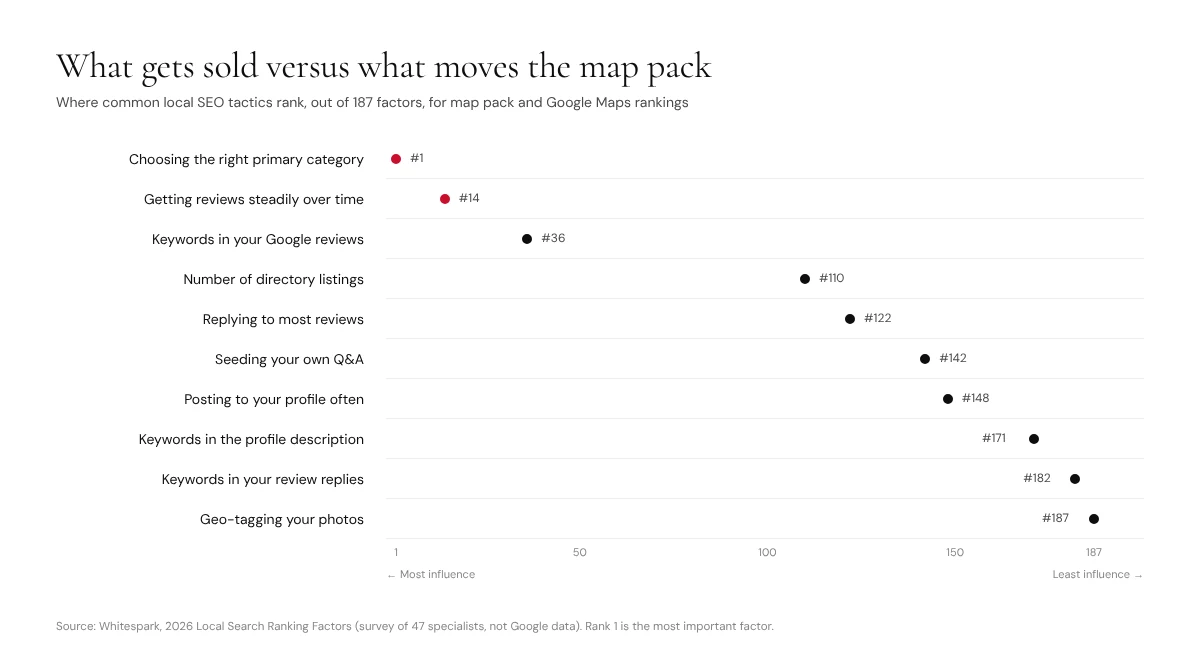
A lot of local SEO budget goes on tasks that are easy to report and hardly move rankings. Whitespark’s survey ranks 187 factors for the map pack, and several of the most-sold tactics sit near the bottom.
“Post every week or Google forgets you”
Post frequency ranks 148th and post quantity 168th. Posts can help a customer who is already on your profile; they will not rescue a profile with the wrong category.
“Geo-tag your photos”
It ranks last, 187th of 187. Real, recent photos of your work help conversions. The location data inside the file does nothing for rankings.
“Put keywords in your review replies”
182nd. Keyword-stuffed replies read badly to the customers who see them. Reply like a person, to the point the reviewer made.
“More directories, higher rankings”
Directory volume ranks 110th. Sterling Sky built 50 citations at once for two businesses and the map pack did not move. Accuracy on the few that matter is the job.
“Keyword your profile description”
171st, and stuffing it is listed as a negative and suspension-risk factor. Use the description to tell customers what you do and why they should pick you.
“Seed your own Q&A”
142nd, and Sterling Sky reports Google replacing traditional Q&A with AI answers drawn from your profile, site and the wider web. Put the answers on your website instead.
None of this means the low-ranked tasks are worthless. It means they come after the fundamentals, and they should never be the bulk of what you pay for. If your monthly report is mostly posts and new listings, ask what happened to the category, the duplicates and the reviews.
Why did my rankings, calls or reviews drop?
Most sudden drops in local search have one of a handful of causes, and the symptom usually points to which. These are the ones we check first, in the order we check them.
Dropped out of the map pack overnight
- Likely cause
- A recent edit (category, name, address or hours), a moved map pin, a suspension, or a spam competitor that appeared above you.
- Check
- Your profile’s edit history and pin location, whether the profile still shows publicly, and who now holds your position.
- Fix
- Reverse the edit or correct the pin. Report fake competitors through Google’s redressal form, with evidence.
Ranking well, but calls are falling
- Likely cause
- AI local packs without call buttons, more ads above the pack, or mobile layouts that show images instead of the call button.
- Check
- Your priority searches on a phone, and calls in your profile’s performance report against the same months last year.
- Fix
- Report on calls and bookings, strengthen the website for the organic result, and test Local Services Ads where they run.
In the map pack, but the website vanished from organic
- Likely cause
- The “diversity update”: Google showing the URL once, in the pack, rather than twice.
- Check
- Whether the page your profile links to is the same page that used to rank organically.
- Fix
- Joy Hawkins’ suggestion is to link the profile to a different page. Test it on one location first: the linked page’s title ranks 17th for the map pack, so the swap can cost as much as it gains.
Reviews disappeared
- Likely cause
- Policy filtering, a spam wave triggering a pause, a recent merge, or reinstatement after a suspension.
- Check
- Whether new reviews are still appearing, and whether you merged or reinstated a profile recently.
- Fix
- Merged reviews can take a few days to show. After a reinstatement, Google’s own help says reviews may be removed and to contact support. Reviews removed for policy breaches are not restored.
Profile suspended
- Likely cause
- Keywords in the business name, an ineligible address (a virtual office or unstaffed co-working desk), a service-area business showing its address, or a service area far beyond two hours’ drive.
- Check
- Every field against Google’s guidelines, before you appeal.
- Fix
- Correct the breach first, then appeal once with proof: business registration, signage photos, a utility bill. Then check your reviews came back.
Never reached the pack, despite months of work
- Likely cause
- A problem nobody looked for: a duplicate profile, a wrong category or an aggregator spreading old details.
- Check
- Search your phone number and every old address; look for a second profile.
- Fix
- Merge or remove duplicates first. A home services business we took on after 18 months of SEO elsewhere had a second profile, created by a former employee, absorbing its reviews. Merged and cleaned up, it reached position one in 14 weeks, and organic calls rose 312%.
If none of these fits, or you paid for local SEO and nothing moved, an independent SEO audit is the faster route than another month of the same work.
Local SEO for AI search
AI answers recommend the businesses the wider web already vouches for. Whitespark’s 2026 survey added AI visibility for the first time, and three of the top five factors are citation factors: mentions on news, association and industry sites, and places on expert-curated “best of” lists. Darren Shaw’s summary is that, in AI search, “mentions (citations) are the new link”.
For a local business, that means the old fundamentals plus three additions. Get onto the “best of” lists for your city and service, which you do by being good and by asking. Collect reviews on the platforms your industry uses, not only Google. And make your website answer the questions customers ask, plainly, because Ask Maps and AI Overviews quote what they can find.
Nobody can guarantee an AI recommendation. We track AI answers for each priority search and judge them by the enquiries they produce. Our research on Google AI Overviews explains how they choose sources, and our AI SEO services cover the work.
What local search is worth
Your map pack position is your most valuable piece of digital real estate. A Texas personal injury firm came to us with a strong reputation and almost no organic visibility, after 14 months of blog content from a previous agency that produced no commercial rankings.
We rebuilt the technical foundation, restructured the practice area pages, built local authority county by county and earned links on real publications. Within 12 months the firm ranked first for its primary commercial searches and first in the map pack.
The client is anonymised for confidentiality. Read the full law firm local SEO case study, or see our lawyer SEO services.
How we run local SEO
Every local engagement runs through the five phases of our REIGN framework, built for each client. Google is clear that there is “no way to request or pay for a better local ranking”, and nobody can promise one. What we commit to is finding what holds you back, fixing it in the right order and measuring what it is worth.
- Reconnaissance
Find what Google believes about you
Profile, categories, duplicates, citations and aggregators, the page your profile links to, and every business in your map pack and AI answers.
- Engineering
Fix before you build
Wrong data and guideline risks first, then the gaps that matter, each ranked by the searches and enquiries it affects.
- Implementation
Do the work in-house
Profile optimisation, service pages, citation cleanup, review process and local mentions. Nothing is outsourced.
- Governing
Report on calls and bookings
Ranking grids for each priority search, AI answers, and calls and bookings by location. When Google confirms a core update, we assess every account within 48 hours.
- Nationwide Dominance
Expand area by area
Into the next county, city or location, with the same master record and the same order of work.
Local SEO: frequently asked questions
What is local SEO?
Local SEO is making a business visible to people searching for it in a specific place. It covers two results: the map pack and Google Maps, which are drawn from Google Business Profiles, and the local organic results below them, which are ranked from websites.
How long does local SEO take?
Fixes to wrong data often show within weeks: we have seen a practice move from position seven to two in six weeks after one aggregator correction. Competing in a crowded market takes longer, and most clients see clear movement within 60 to 90 days.
What is the most important local ranking factor?
Distance from the searcher matters most, but you cannot change it. Of the factors you control, the primary Business Profile category ranks first of 187 in Whitespark’s 2026 survey of local search specialists, followed by honest hours, ratings and a steady flow of reviews.
Can I rank in a city where I don’t have an address?
Rarely in the map pack, which is anchored to where your business is. You can rank in local organic results for other areas with a dedicated page and real content about the service there. Opening a staffed location is the only reliable way into another city’s map pack.
What is the difference between local SEO and national SEO?
Local SEO competes for searches tied to a place and depends heavily on your Business Profile, location and reviews. National SEO competes for searches with no place attached and depends on content and links. Many businesses need both, in different proportions.
Does local SEO work for service-area businesses?
Yes, within Google’s rules: hide your address if customers do not visit it, set a service area no larger than about two hours’ drive, and expect to rank most strongly near your base. Use service and area pages on your website to compete further out.
Is local SEO worth it for a small business?
For a business whose customers search nearby, it is usually the highest-return marketing channel, because the searcher is ready to call. Start with the free fundamentals: the right category, accurate details, honest hours and asking every customer for a review.