Local SEO for law firms: what the map pack takes in your practice area
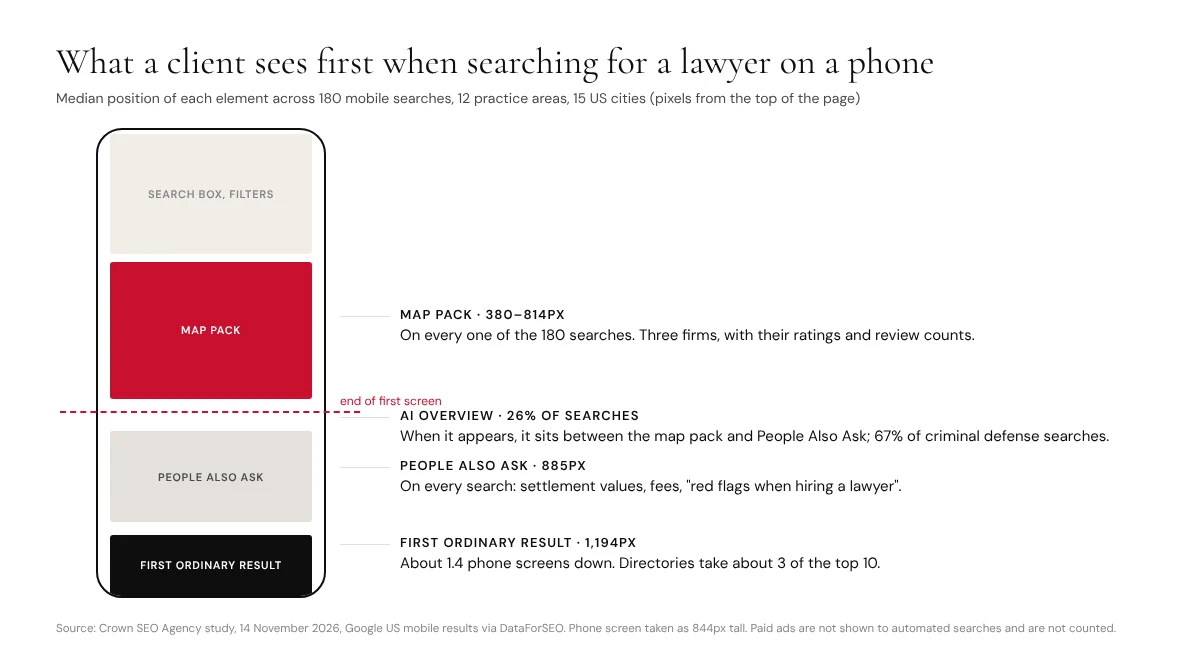
Local SEO for law firms is the work that puts each of your offices in the map pack and local results for the cases you handle. It matters more than any other part of a law firm’s search: in our study of 240 lawyer searches across 15 US cities, the map pack appeared on every one, and the first ordinary result sat about one and a half phone screens down.
The short answer
- The map pack is the front door. It appeared on all 240 searches in our study, above every ordinary result.
- Fix your listings before anything else. Different versions of your name, old suite numbers and tracking numbers quietly hold firms back.
- Give every office its own profile and its own pages. One citywide page per practice area cannot rank for thirteen offices.
- Know the review bar in your practice area. Map pack firms average about 1,300 reviews for personal injury searches, and about 150 for estate planning.
- Measure calls and signed cases, not rankings alone.
Most local SEO advice is written for plumbers and restaurants. Law firms have different rules for their profiles, stricter rules for their advertising, directories that compete for the same searches, and review counts that vary almost ninefold between practice areas. This guide is written for them, using data we gathered in November 2026 and three firms we have worked with.
What clients see when they search for a lawyer
On a phone, a client looking for a lawyer sees the map pack before anything else. We searched 12 practice areas from 15 large US cities, on mobile and desktop, 240 searches in total, and recorded every element on the page.
The review bar differs enormously by practice area.
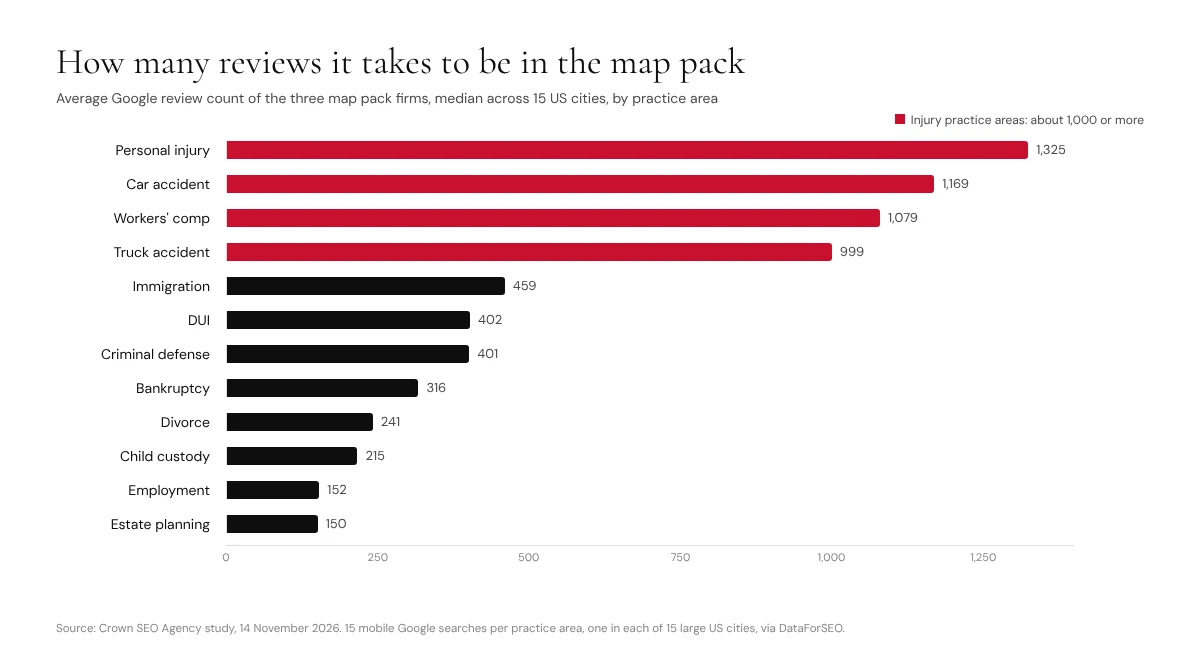
The table shows the average review count of the three firms in the map pack, taken as the median across our 15 cities, with the share of searches that showed a Google AI Overview and the average number of directories in the top ten.
| Practice area | Map pack reviews | Rating | AI Overview | Directories in top 10 |
|---|---|---|---|---|
| Personal injury lawyer | 1,325 | 4.90 | 27% | 3.5 |
| Car accident lawyer | 1,169 | 4.90 | 27% | 2.3 |
| Workers’ comp lawyer | 1,079 | 4.87 | 40% | 1.9 |
| Truck accident lawyer | 999 | 4.92 | 7% | 0.7 |
| Immigration lawyer | 459 | 4.90 | 27% | 2.9 |
| DUI lawyer | 402 | 4.97 | 27% | 2.6 |
| Criminal defense lawyer | 401 | 4.97 | 67% | 5.1 |
| Bankruptcy lawyer | 316 | 4.93 | 7% | 4.0 |
| Divorce lawyer | 241 | 4.83 | 20% | 5.6 |
| Child custody lawyer | 215 | 4.80 | 20% | 3.2 |
| Employment lawyer | 152 | 4.73 | 13% | 3.4 |
| Estate planning lawyer | 150 | 4.97 | 33% | 3.1 |
Source: Crown SEO Agency study, 14 November 2026. 15 mobile searches per practice area, one in each of New York, Los Angeles, Chicago, Houston, Phoenix, Philadelphia, San Antonio, San Diego, Dallas, Atlanta, Miami, Denver, Seattle, Las Vegas and Charlotte, collected through DataForSEO. Paid ads are not counted, because Google does not show them to automated searches.
Two things stand out. Injury firms compete on volume: a personal injury firm with 200 reviews is far below the firms it is trying to join. And family and criminal law searches carry the most directories, so a firm’s own listing has fewer places to win, and its directory profiles matter more.
How Google ranks law firms in the map pack
Google ranks local results on three things, and you control two of them. In its own words, local results are “mainly based on relevance, distance, and popularity”, and “there’s no way to request or pay for a better local ranking” (Google Business Profile Help). Distance from the person searching is fixed; relevance and prominence are where the work is.
Local search specialists rank the primary Business Profile category first of 187 factors, distance second, and an address in the city searched fourth (Whitespark, 2026 Local Search Ranking Factors). For law firms the category is where we find the most mistakes. A generic category such as “Lawyer” makes a firm less relevant for “personal injury attorney” or “divorce lawyer” searches than the firms that chose the specific one.
Law firms also have their own rules. Google treats lawyers as individual practitioners: an attorney who meets clients can have a profile of their own, but where several attorneys work from one office, “the organization should create a Business Profile for this location, separate from that of the practitioner”, and the attorney’s profile should carry only the attorney’s name (Google’s guidelines). Set up well, attorney profiles add visibility. Set up badly, they compete with the firm’s own.
Our local SEO guide covers how the map pack works for any business. The rest of this page is what is different for law firms.
Local SEO for law firms: the order we work in
Fix what Google believes about the firm first, then build. This is the order our local SEO services follow for law firms, and each step comes from a firm we have worked with:
- Make every listing agree.
- Choose the right category for each office.
- Give every office its own pages.
- Build reviews to your practice area’s bar.
- Set up attorney profiles properly.
- Earn local authority where you want to win.
- Measure calls and signed cases.
1. Make every listing agree
Use one version of the firm’s name, address and phone number everywhere, and correct the rest at the source. Law firms rename, add partners, move suites and buy call-tracking numbers, and each change leaves old details behind on directories and data aggregators.
A two-office family law firm in San Francisco came to us with its name in several versions across its listings, old addresses and suites still showing, and old or call-tracking phone numbers on some of them. Cleaning that up, alongside the other steps here, took both offices into the map pack top three within six months. Our guide to local citations explains how to audit yours.
2. Choose the right category for each office
Pick the most specific primary category for the cases each office wants most, and check what the firms above you use. A single-office legal practice we worked with had the wrong primary category and inconsistent details across 14 citation sources. Fixing both, with LocalBusiness markup on its site, put it in the top three for 27 high-intent searches within 90 days, and enquiries tripled.
3. Give every office its own pages
Build a page for each case type and for the areas each office serves, and link each office’s profile to its own page. A Los Angeles personal injury firm with 13 offices had one generic page per practice area, so no office had anything to rank with. With pages for each case type and office area, and every office profile fixed, 9 of its 13 offices reached the map pack top three within 12 months.
4. Build reviews to your practice area’s bar
Find the review count of the firms in your map pack and build a steady process to close the gap. Specialists rank star rating 6th and review count 9th for the map pack, and the study table above shows how far apart practice areas are. A steady flow beats a burst, both for rankings and for Google’s spam filters. The next section covers the rules.
5. Set up attorney profiles properly
Give public-facing attorneys their own profiles only where Google’s rules allow, named for the attorney alone. Keep the firm’s office profile separate, use the right category on each, and make sure the attorney’s profile links to their own bio page, not the home page.
6. Earn local authority where you want to win
Get mentioned and linked by local news, bar associations and community organisations in each area you serve. A Texas personal injury firm we worked with had a strong reputation and almost no organic visibility. Building local authority county by county across 12 counties, with the technical and page work alongside, took it to #1 in the map pack within 12 months.
7. Measure calls and signed cases
Track calls, forms and signed cases by office, from your intake records. Map pack positions are a means. Both of our Californian firms judged the work on their own intake data, which is the number a managing partner trusts.
Reviews, and the bar’s advertising rules
Reviews are a ranking factor and a form of lawyer advertising, so they sit under your state’s rules as well as Google’s. California’s Rule 7.1 is a typical example: a testimonial can be misleading if it leads a reasonable person “to form an unjustified expectation that the same results could be obtained for other clients”, and “an appropriate disclaimer or qualifying language often avoids creating unjustified expectations”.
- Ask every satisfied client, privately and at the right moment, usually when the matter closes. Never offer anything in return; Google’s policies prohibit incentivised reviews.
- Reply without confirming anyone was a client. Even a reply to an unfair review must not reveal anything about a matter. Thank people, and take disputes offline.
- Where you quote reviews on your own site, add the qualifying language your state’s rules call for.
We cover the fee and advertising rules in more depth on our personal injury lawyer SEO and family law SEO pages. Your ethics counsel has the final word.
Directories and AI answers in local legal search
Directories are competitors and allies at the same time. They took an average of 3.2 of the top ten ordinary results in our study, and up to 5.6 for divorce searches, but a complete, consistent profile on Justia, FindLaw, Avvo and your state bar’s directory is also a citation that supports your own listing. Claim them, complete them, and keep them identical to your Business Profile.
Google showed an AI Overview on 26% of the mobile searches, rising to 67% for criminal defense. The sources it cited most were Reddit, Cornell’s Legal Information Institute, Wikipedia, Lawyers.com and YouTube, rarely individual firms. Clear answers on your own practice pages, a presence on the directories it trusts, and genuine participation where clients ask questions are what get a firm into those answers. Our AI SEO services cover that work.
Results for three law firms
Map pack across 12 Texas counties, organic traffic up 664% and qualified enquiries up 312%.
Read the case studyOffices in the map pack top three, organic traffic more than tripled, with no paid ads running.
Read the case studyOffices in the map pack top three, organic enquiries up 50 to 100%, reviews roughly doubled.
Read the case studyFour local SEO mistakes law firms make
Keywords in the firm’s name
“Smith Law | Car Accident Lawyer Houston” may rank for a while. Google’s guidelines say the name must match the real-world name, and a suspended profile ranks for nothing.
A virtual office in every city
Google does not allow profiles at virtual offices or unstaffed co-working desks. Open a real, staffed office, or win those areas through your website instead.
Attorney profiles that compete with the firm
An attorney profile with the firm’s name, the same category and the home page as its link splits the firm’s own visibility.
A review burst after a campaign
Fifty reviews in a week, then nothing, looks exactly like what Google’s filters remove. Ask every client, every week.
Local SEO for law firms: frequently asked questions
What is local SEO for law firms?
It is the work that puts each of a firm’s offices in Google’s map pack and local results for the cases it handles: accurate listings, the right categories, a page for each case type and area, reviews, and local authority. It matters because the map pack appears above ordinary results on lawyer searches; in our study of 240 searches it appeared on every one.
How many Google reviews does a law firm need?
It depends on the practice area. In our November 2026 study, map pack firms averaged about 1,300 reviews for personal injury searches, about 400 for criminal defense and DUI, about 240 for divorce and about 150 for estate planning. Check the firms in your own map pack and build a steady process to close the gap.
Can each attorney have their own Google Business Profile?
Yes, if they are public-facing and can be contacted at the verified location during stated hours. Where several attorneys share an office, the firm needs its own profile for that location, and each attorney’s profile should carry only the attorney’s name.
Can a law firm rank in a city where it has no office?
Rarely in the map pack, which is anchored to a real, staffed address. Google does not allow virtual offices. A firm can rank in ordinary results for other areas with pages about the services it offers there.
How long does local SEO take for a law firm?
Fixes to listings and categories can show within weeks. In our work, a two-office family law firm reached the map pack top three in six months, and multi-office personal injury firms were measured at twelve months.