SEO for technology companies: build it around how you sell
SEO for technology companies works when it is built around how you sell, not around traffic. Get three things right: a site Google can actually read, pages for the searches buyers make before they shortlist, and reporting in pipeline. Most tech companies get the first one wrong without knowing it.
The short answer
- Pick the playbook that matches how you sell. Self-serve SaaS, sales-led software, IT services and development firms need different pages.
- Fix rendering before you write a word. If your content only appears after JavaScript runs, Google may not see it.
- Target the searches closest to a shortlist: comparisons, alternatives, integrations and evaluator questions.
- Build pages AI answers can quote. All 40 searches about SEO for tech companies in our data show a Google AI Overview.
- Report pipeline and acquisition cost, not sessions.
For one Series B SaaS client, getting those five right took organic search from zero to $340K in monthly pipeline. The rest of this guide shows how each one works.
Why is SEO different for technology companies?
Google ranks a software company with the same systems it uses for everyone else. The market is what changes, in four ways that each change what you should build.
1. Your buyers can tell who has done the work
Put the people closest to the product into the content. An engineering lead knows within a paragraph whether the writer has worked in the category. Google asks a similar question of every page: does it show “first-hand expertise and a depth of knowledge”? (Google Search Central).
2. Nobody buys alone, and nobody buys quickly
Build a page for each buyer role and stage. A software purchase has a user, an evaluator, a budget holder, and procurement and security reviewers. Each one searches differently, so one page written for “the buyer” serves none of them.
3. You compete with review sites as well as rivals
Give buyers what review platforms cannot. Category and comparison searches put review sites on page one next to vendors. Your edge is specifics: your product, your integrations, your results.
4. Your stack can hide your content from Google
Check what Google sees, not what your browser shows. Tech marketing sites use the same JavaScript frameworks as the product. A site can look perfect in a browser and be close to empty in Google’s index, which is the most expensive problem we find.
SEO for software companies: four playbooks, depending on how you sell
Choose your playbook before you choose a single keyword. “Technology company” covers businesses that win customers in completely different ways, and most generic advice fails because it mixes them up.
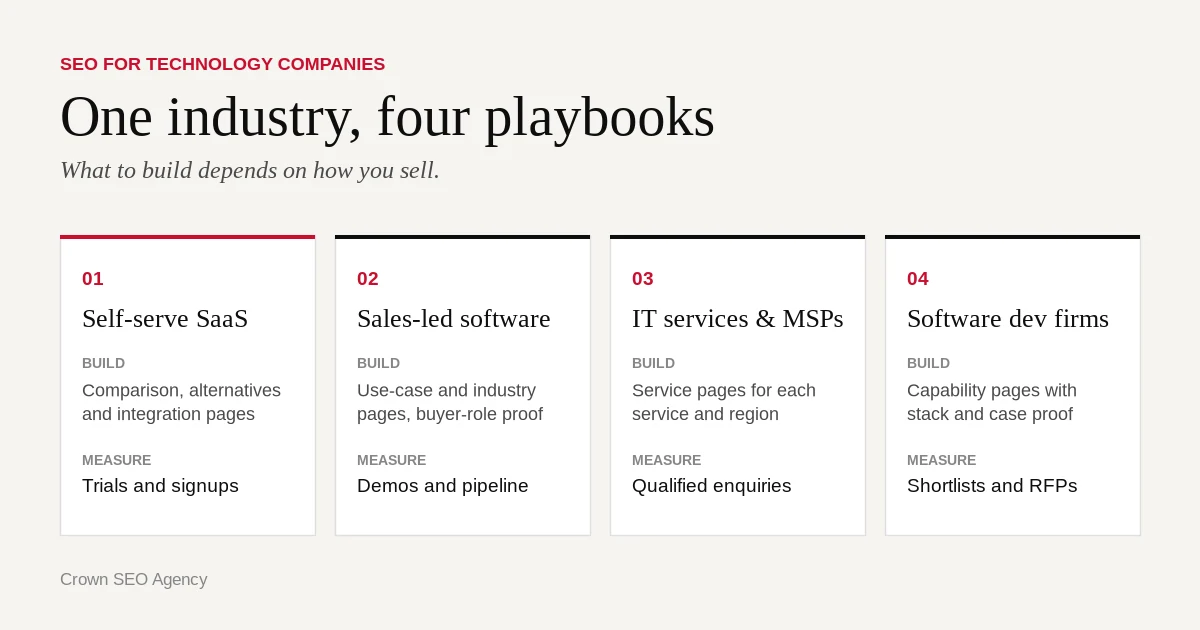
| How you sell | Searches that convert | Pages to build first | What to measure |
|---|---|---|---|
| Self-serve SaaS (free trial or freemium) | “[category] software”, “[competitor] alternatives”, “[tool] integration with [tool]” | Comparison and alternatives pages, integration pages, use-case pages, templates | Trials, signups, activated accounts |
| Sales-led software (demo first, enterprise) | Problem-led and industry-specific searches, “[category] for [industry]”, security and compliance questions | Industry and use-case pages, proof for each buyer role (ROI, security, implementation) | Demo requests, opportunities, pipeline value |
| IT services and MSPs | “managed IT services [city]”, “[service] support for [industry]” | One page for each service, location pages backed by real local proof | Qualified enquiries and calls |
| Software development companies | “[technology] development company”, “[industry] software development” | Capability pages for each stack and industry, case studies with the technical detail | Shortlist invitations, RFPs, discovery calls |
How we read it:
- Start closest to the shortlist. Comparison, alternative and integration searches are small, but the people making them are already deciding.
- Sales-led software needs proof for every stakeholder. Answer the evaluator, the budget holder and the security reviewer, and SEO shortens the sales cycle instead of just filling the top of it.
- Only IT services firms need local SEO. Software companies selling nationally or globally can ignore it.
The first two rows are what our SaaS SEO services are built around. Services firms selling to other businesses, see B2B SEO.
If Google can’t read it perfectly, nothing else matters
Run these five checks before you spend anything on content or links:
- Your selling content is in the server’s HTML, not only in the browser.
- Every app route returns a real URL and a real status code.
- Your documentation is crawlable and linked from the main site.
- Staging, app and preview pages are kept out of Google’s index.
- You know what Google actually crawls, from your server logs.
We once found 11 product pages of a $18M ARR SaaS company indexed by Google as empty shells. Every one of these checks exists because of problems like that.
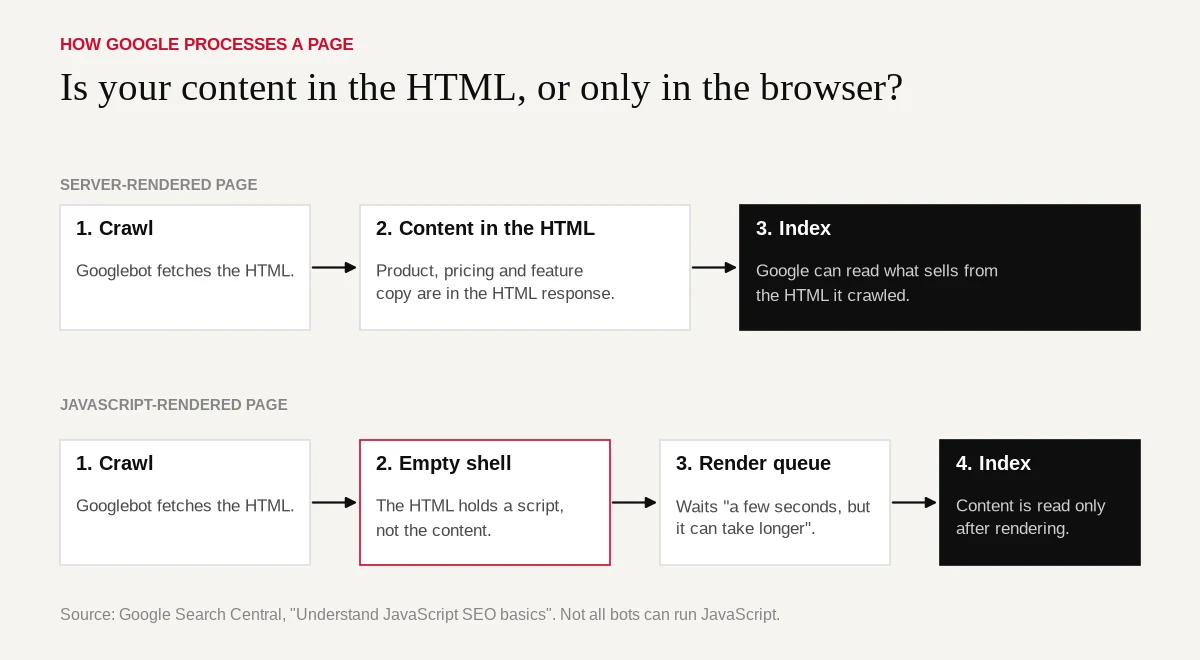
1. Put the content that sells in the HTML
Open the raw HTML your server sends for a product page. If the content is not in it, fix that first. Google renders JavaScript in a queue, where a page “may stay on this queue for a few seconds, but it can take longer than that” (Google Search Central). Google’s own advice: “server-side or pre-rendering is still a great idea because it makes your website faster for users and crawlers, and not all bots can run JavaScript.”
2. Make app routes behave like pages
Replace fragment URLs and return real status codes. Google tells developers to “use the History API instead of fragments” (#/features). Error pages that return a 200 create soft 404s and fill the index with empty pages, and neither problem is visible in a browser.
3. Make your documentation work for you
Subdomain or subfolder matters less than crawlable, linked and current. Google’s position is to “do whatever makes sense for your business” (Google SEO Starter Guide). Docs answer the exact questions evaluators search for; orphaned on a separate platform, they are wasted.
4. Keep staging and app pages out of the index
Block them with authentication or noindex. Staging sites, logged-in screens, preview deployments and internal search results leak into Google on tech sites more than on any other kind we audit. They compete with your real pages.
5. Read your server logs
Logs are the only reliable record of what Google requests and ignores. Crawl budget only matters at scale: Google’s guide is for sites with “1 million+ unique pages” changing weekly, or “10,000+” changing daily (Google Search Central). Integration directories and programmatic pages get there fast. Our technical SEO work covers the rest.
What fixing the foundation was worth
A Series B workflow automation company came to us with a JavaScript-rendered site, 11 product pages indexed as empty shells, and zero organic pipeline. By month 14, organic was its second-highest source of pipeline.
We rebuilt the technical foundation the product pages sat on, built AI Overview citations from zero, and launched a content programme for buyers in the evaluation stage. The client is anonymised for confidentiality. Read the full SaaS SEO case study.
How we build SEO for technology companies
Every technology engagement runs through the five phases of our REIGN framework, built bespoke for each client. Nobody can guarantee rankings; what we commit to is finding what holds your site back, fixing it in the right order, and measuring what it is worth.
- Reconnaissance
Find where pipeline is leaking
A full technical crawl, rendering and log file analysis, every ranking competitor reverse-engineered, and the AI Overview landscape for your category. Each gap gets a revenue value.
- Engineering
Choose the playbook and the order
A 90-day plan matched to how you sell. Technical fixes come before content, because there is no point sending traffic to pages Google cannot read.
- Implementation
Build it in-house
Development tickets with full specifications, evaluation-stage content, original data and authority links. Nothing is outsourced.
- Governing
Report on pipeline
Monthly reporting on demos, opportunities and pipeline by page. When Google confirms a core update, we assess every account within 48 hours.
- Nationwide Dominance
Compound it
Expand into adjacent use cases, industries and markets, with hreflang and an international keyword strategy when you sell abroad.
SEO keywords for an IT or tech company: start where your buyers start
Target the searches your buyers make, not what your company calls itself. Map them to your ideal customer profile, so the traffic you win is the traffic your sales team wants. Build them in this order:
- Problem searches. What the buyer types before they know your category exists: “how to reduce employee onboarding time”, not “HR onboarding platform”.
- Category and comparison searches. “[category] software”, “best [category] for [industry]”, “[competitor] alternatives”, “[you] vs [competitor]”.
- Integration searches. “[your product] + [tool they already use]”. Small volumes, very high intent, rarely contested.
- Evaluator questions. Security, compliance, implementation time and pricing model. Answering them on your site shortens the sales cycle.
Volume is the least important number. Fifty searches a month from buyers who match your profile beat 5,000 from students. Value each cluster by expected conversion rate and contract value before you build.
The content follows the keywords. For our workflow automation client, that meant comparison pages fair enough for buyers to trust, one page per meaningful integration, use-case pages for specific roles, and case studies with real numbers. Each sits in a topic cluster, because that structure is how Google judges the depth of what you know.
How do tech companies get cited in AI search?
Be indexed, be eligible for a snippet, and publish the pages AI answers quote: comparisons, integrations, documentation, original data and clear answers to evaluator questions. That matters because AI Overviews are now your B2B buyer’s first research touchpoint. All 40 searches about SEO for tech companies in our data show one, and across SEO searches our research on Google AI Overviews found 84% do.
- Google uses normal Search eligibility. There are “no additional requirements” and no special markup (Google Search Central). Snippet controls such as nosnippet limit how you appear; Google-Extended does not affect Search.
- Other AI assistants run their own crawlers. Decide in robots.txt which ones you allow, then check your CDN or firewall is not blocking them anyway. We find the silent block far more often than the deliberate one.
- Keep the content that matters in the HTML. “Not all bots can run JavaScript.” Empty product pages keep you out of AI answers as surely as out of rankings.
Our workflow automation client went from zero to 29 AI Overview citations, out of 47 queries tracked, in five months. Nobody can guarantee a citation, so we track them per keyword, set up AI assistant referrals as their own channel in GA4, and judge both by the pipeline they produce. That is the core of our AI SEO and GEO work.
Measure pipeline and acquisition cost, not traffic
Report these three numbers, in this order:
- Organic pipeline: demos, trials and opportunities from organic search, by landing page, joined to your CRM.
- Organic acquisition cost against paid: your organic investment divided by the customers it won, next to your paid CAC. Track it at month 6, 12 and 24; organic compounds, so the gap widens. Our SaaS client’s settled at $180 against $1,240.
- Commercial visibility: rankings and AI Overview citations for the searches closest to purchase, not a total keyword count.
If traffic grows and pipeline does not, that is not an SEO success. It means the content is reaching the wrong people, and we will say so before you have to ask.
Three mistakes we see on technology sites
Judging SEO on paid-search timelines
Cutting it after a quarter because it did not behave like Google Ads. Most clients see movement within 60–90 days, and the return compounds for years after that.
Blogging for an audience that does not buy
High-volume posts that attract students and job seekers. Comparison, integration and use-case pages are less glamorous and produce far more pipeline.
Leaving technical SEO to the dev team alone
Developers build for users and speed. Without SEO requirements in the ticket, rendering, routing and indexing problems ship with every release.
SEO for technology companies: frequently asked questions
How is SEO for tech companies different from other SEO?
Google’s ranking systems are the same; the market is not. Tech buyers are technical and research for longer, several people sign off on each purchase, review sites compete for the same searches, and JavaScript-built sites create rendering and indexing problems most businesses never face.
How long does SEO take for a software company?
Most clients see movement within 60–90 days. Treat organic as a 6–12 month investment that keeps compounding after that. For one Series B SaaS client, organic grew from zero to $340K in monthly pipeline over a 14-month engagement.
Should documentation sit on a subdomain or a subfolder?
Google says to do whatever makes sense for your business. What matters more is that the documentation is crawlable, linked from your main site and kept up to date, because it answers the exact questions technical evaluators search for.
Do IT services companies and MSPs need local SEO?
Yes, if you sell within a region. Build a page for each service and area, keep your Google Business Profile complete, and earn reviews. Software companies selling nationally or globally can ignore local SEO.
How does a tech company get cited in ChatGPT and Google AI Overviews?
For Google, a page must be indexed and eligible for a snippet; there is no special markup. The pages that get cited answer specific questions clearly: comparisons, integrations, documentation and original data. Allow the AI crawlers you want in robots.txt, check your firewall is not blocking them, and keep key content in the HTML rather than behind JavaScript.
What should a technology company measure in SEO?
Organic pipeline first: demos, trials and opportunities by landing page. Then organic acquisition cost against your paid CAC, and rankings and AI Overview citations for the searches closest to purchase. Total traffic is the least useful number.